


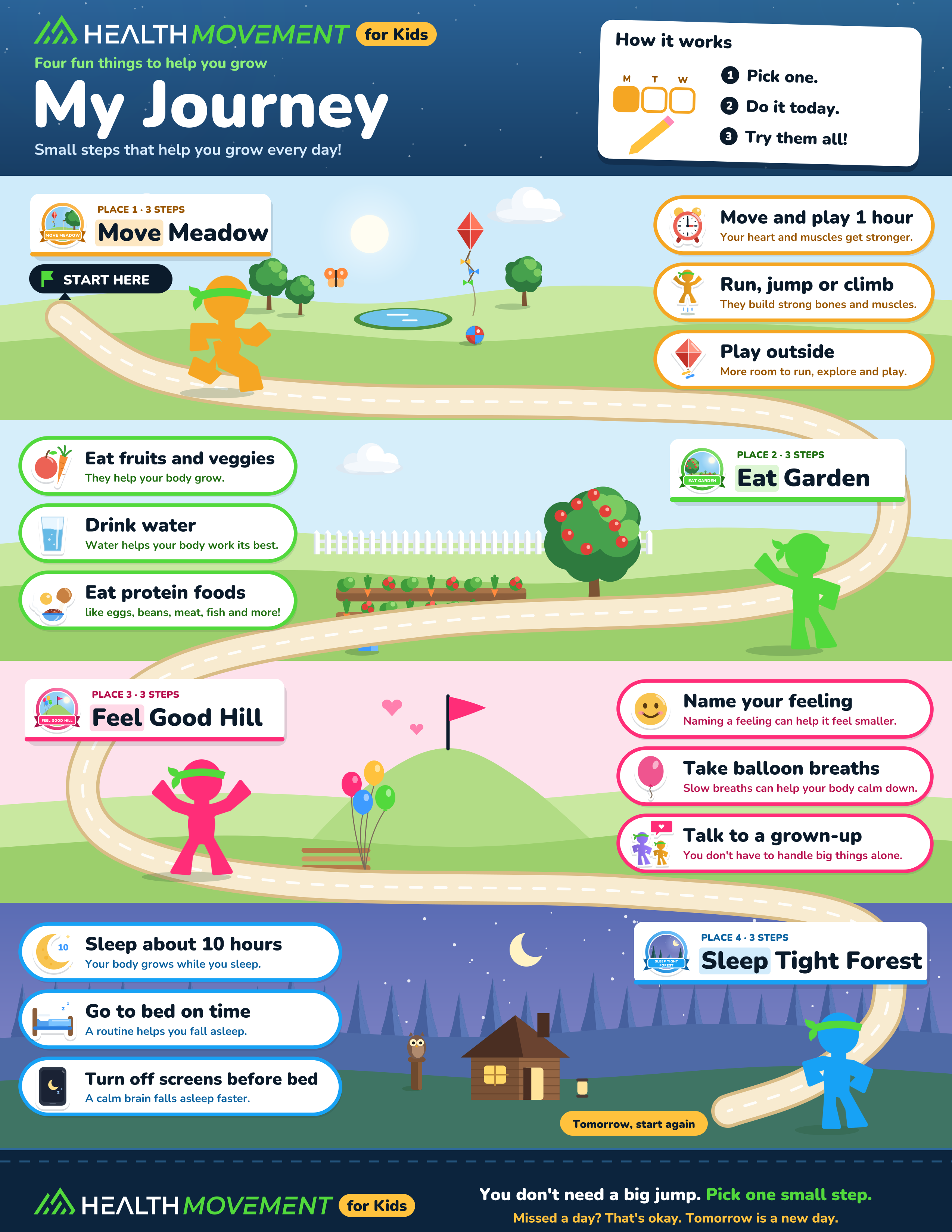
My Journey guideline poster
The 12 guidelines, three in each place, with a picture and a why line for each. Letter, K to 5.
Letter, portrait
Download PNG
Start here: parents
Everything your family needs fits on a poster and a weekly tracker. Pick one small step, do it together, color it in.
A note from Rich
I'm Rich Millar, MPH, and a dad of three. I built Health Movement for Kids because family habits matter a lot: how we eat, move, rest and talk to each other at home.
This is not about your child's body, and it will never ask you to weigh, measure or compare anyone. It is about small things your whole family can do together, one step at a time. Pick one. That's plenty.
Rich Millar, MPH
Founder, Health Movement
How it works
Never use the tracker for rewards, punishments or comparing siblings. The numbers on it, like 1 hour of play and about 10 hours of sleep, are child guidance from child-health sources.
The 12 guidelines
 Move and play 1 hour
 Run, jump or climb
 Play outside
Children and teens 6 to 17 need at least 60 minutes of physical activity a day, and it can add up across the whole day. On at least 3 days a week that includes activity that makes muscles strong, like climbing, and on at least 3 days activity that makes bones strong, like jumping and running. Children 3 to 5 need to be active throughout the day.
Ideas and what to say Eat fruits and veggies
 Drink water
 Eat protein foods
Grown-ups decide what food is offered, when and where. Children decide whether to eat it and how much. This is Ellyn Satter's division of responsibility in feeding.
Ideas and what to say Name your feeling
 Take balloon breaths
 Talk to a grown-up
The kid pages teach four tools: slow balloon breaths, naming a feeling, saying one thing you're thankful for, and telling a grown-up when something is hard.
Ideas and what to say Sleep about 10 hours
 Go to bed on time
 Turn off screens before bed
Per 24 hours, including naps, the American Academy of Sleep Medicine, with the American Academy of Pediatrics, recommends 10 to 13 hours for ages 3 to 5 and 9 to 12 hours for ages 6 to 12. "About 10 hours" fits inside both.
Ideas and what to saySay this, not that
Print these first
The 12 guidelines, three in each place, with a picture and a why line for each. Letter, K to 5.
Letter, portrait
Download PNG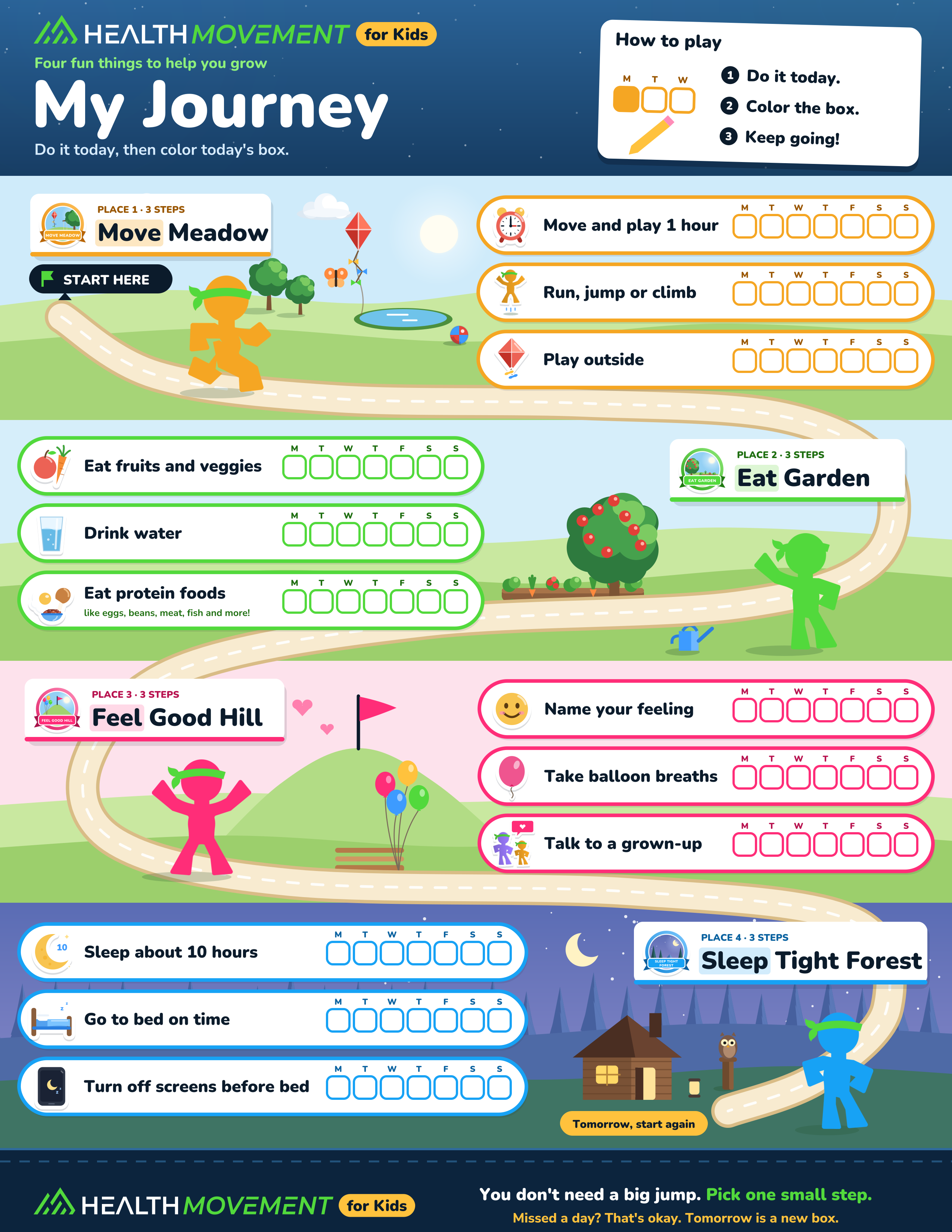
Color a box on a day you did it. One page per week. Letter, K to 5.
Letter, portrait
Download PNG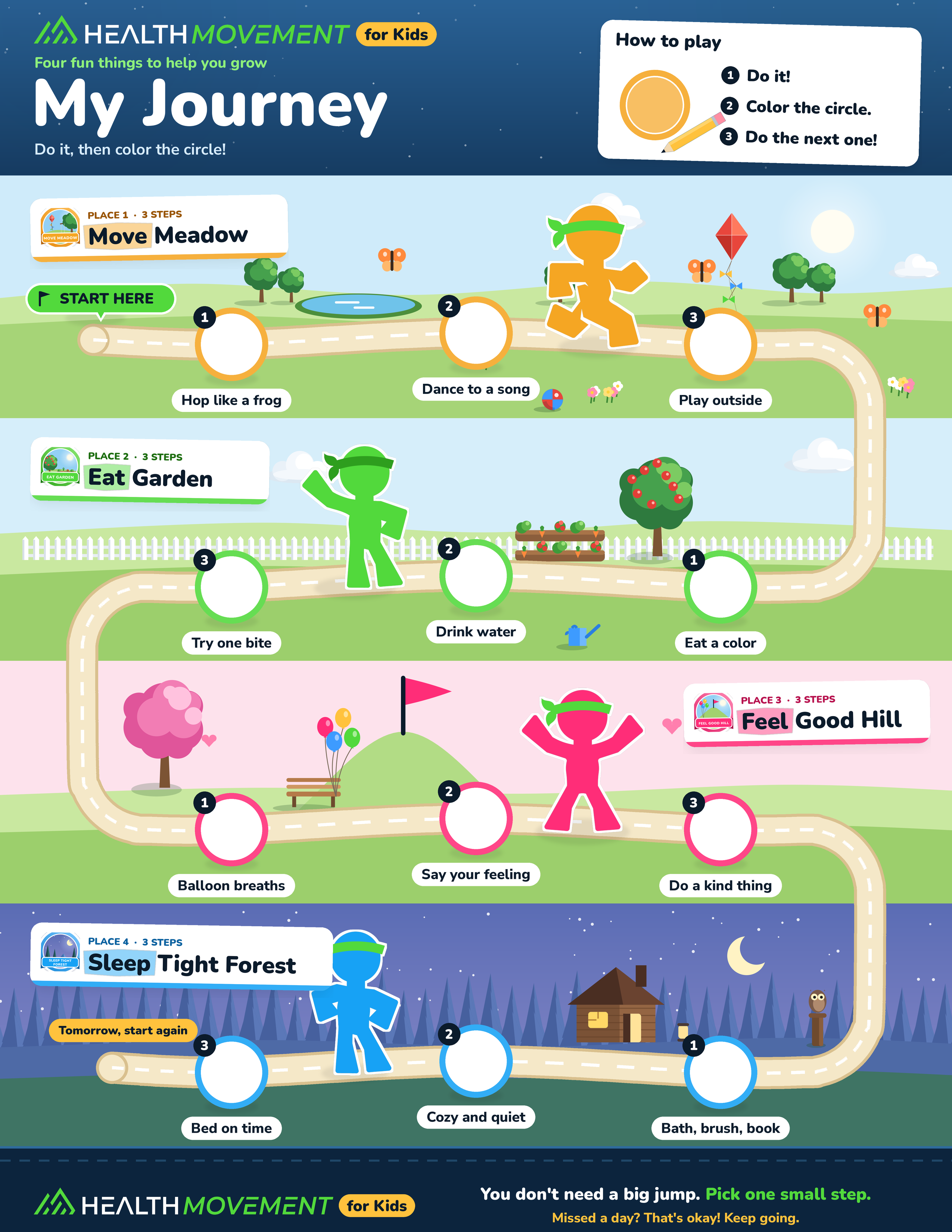
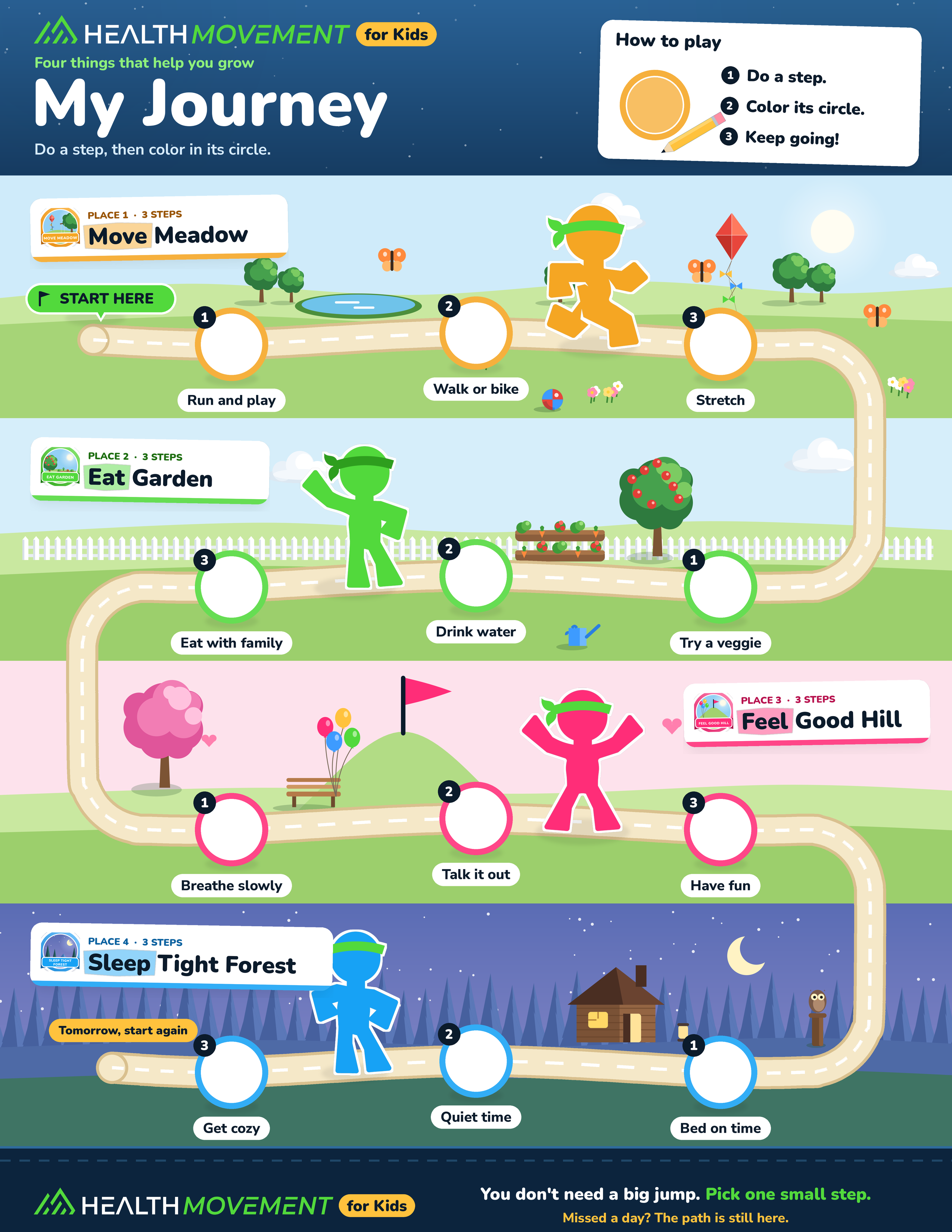
The path through the four places, with three circles to color in each.
Letter, portrait
Download PNG
An eight-page story to read together: the character walks through all four places.
Letter, landscape, 8 pages
Download PDFIf your child's class is on the journey, the Our Family's Week tally sheet comes home. No names needed.
Show your kid
Open the kid part together. Your kid picks a place, hears it read aloud and taps "I did it". The character hops, and that's it: nothing is saved, nothing is scored and there is nothing to sign up for.
If a child is in crisis: call or text 988, the Suicide and Crisis Lifeline, any time. In an emergency, call 911.
This is educational information, not medical advice. Questions about your child's health or growth? Talk with your pediatrician.